

Multiple Sclerosis (MS) and Fibromyalgia are considered “invisible illnesses” that disrupt your sleep and impair your thinking. But even if they seem alike on a Tuesday morning when you can’t get out of bed, what’s going on inside you is very different.
Here in Australia, getting the right label on these symptoms isn’t just about peace of mind. It’s about safety. Using painkillers for MS won’t prevent damage. Also, treating fibromyalgia with strong immune suppressants carries unnecessary risks.
Here’s how to distinguish between multiple sclerosis and fibromyalgia symptoms in Australia.
Key Takeaways:
- Spot overlap fast: MS and fibromyalgia can share fatigue, pain, and brain fog.
- Know the key difference: MS shows nervous-system damage; fibromyalgia is pain amplification without lesions.
- Act on red flags: Sudden vision loss, new walking trouble, or severe focal pain needs urgent care.
- Get evaluated early: Earlier diagnosis supports better long-term symptom control and safer treatment choices.
- Build a support team: Use a GP coordinator, specialists, allied health professionals, family members, and telehealth services.
First, Why do MS and Fibromyalgia Get Confused?
What Is Multiple Sclerosis?
Basic Overview of Multiple Sclerosis
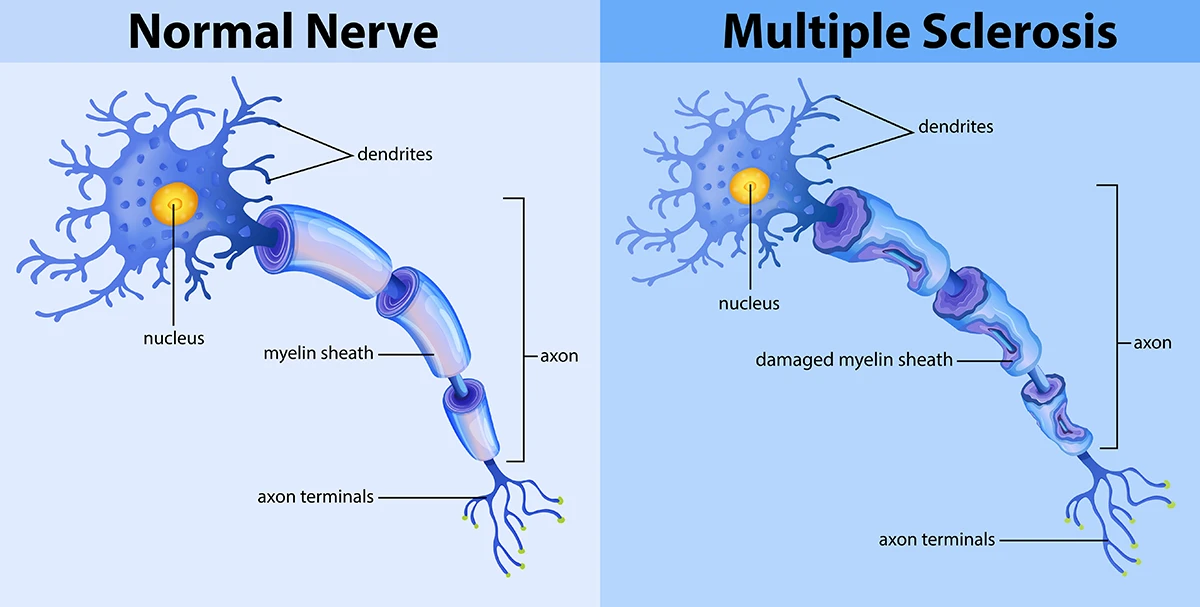
Typically, your immune system acts as your body’s defense system. In Multiple Sclerosis, your immune system gets confused. It attacks that protective coating in your brain and spinal cord. This strips the nerves bare, a process called demyelination. Signals from your brain get blocked or short-circuited. If damage happens to the optic nerve, you lose vision. If it hits the spinal cord, you trip over your own feet.
The scary part, and why neurologists move fast, is that this damage leaves permanent scars (lesions).
How It Affects the Nerves: The Short "Circuit"
In MS, the immune system “chews” on that protective plastic coating. When the coating is damaged, the electricity inside can leak out or get blocked. This creates a short circuit.
Even if the brain tries to send a command to your leg to kick,the signal may be distortedor completely lost because of frayed or damaged wires and nerves. This is why people with MS might feel weak or clumsy.
Common Types of Multiple Sclerosis
Doctors usually group MS into a few types. The two most common patterns are:
Relapsing-Remitting: This is the most common onset type (85%). It acts like a rollercoaster of inflammation: for a moment, you feel the symptoms; the next, you do not. It goes up and down. You might have a flare-up where you feel sick for a while, but then your body realigns the wires a bit, and you feel better (remission) for a long time.
Primary Progressive: Affecting about 10–15% of patients, this type does not follow the rollercoaster pattern. Symptoms slowly and steadily get a little tougher to deal with over time, without breaks when you feel better.
What Is Fibromyalgia?
Basic Types of Fibromyalgia
How Does Fibromyalgia Affect the Body?
Is Fibromyalgia a Progressive Disease?
No. Fibromyalgia is not a progressive degenerative disease. New studies using VBM show that people with fibromyalgia have changes in brain structure. They lose gray matter volume in areas that control pain. Regardless, this condition is still not considered progressive. These changes are neuroplastic. Meaning, it’s the brain’s reaction to chronic pain, not the cause of tissue death
Symptoms of Multiple Sclerosis
Common Physical Symptoms
Vision Issues (Optic Neuritis): The optic nerve gets inflamed. This causes blurry vision, pain when moving the eyes, or even temporary blindness in one eye.
Clumsiness and Balance Issues: MS has trouble with coordination. People might feel dizzy (vertigo) or have shaky hands when trying to pick something up.
Muscle Spasms (Spasticity): MS disrupts upper motor neuron signaling. This causes stiffness or uncontrollable twitching (spasms), especially in the legs.
Cognitive and Sensory Symptoms
Phantom Zaps (Ectopic Burst Generation):Nerves experience spontaneous firing of action, even in the absence of stimulus. A person feels pins and needles (paresthesias) or burning for no reason.
The Neck Shock (Lhermitte’s Sign): A person bends his/her neck forward, stretching the inflamed dorsal columns of the spinal cord.
Sensory Ataxia: The brain cannot receive signals from the limb position. Meaning, a person cannot “feel” where the ground is.
“Cog Fog”: MS damages long-range white matter tracts that connect brain regions. A person experiences slowed processing, also known as reduced information processing speed (IPS).
Compensatory Overload: MS patients recruit wider areas of the brain to perform simple tasks. Therefore, the brain experiences “cognitive fatigue”.
Symptoms That May Change Over Time
Symptoms of Fibromyalgia
Widespread Pain and Sensitivity
Fatigue and Sleep-Related Issues
Sleep doesn’t seem to fix tiredness. In patients with fibromyalgia, faster alpha waves (8-13 Hz), normally seen when a person is awake and relaxed, superimpose on the slow delta rhythm. This means deep, sound sleep is rare.
Cognitive Symptoms Often Reported
Key Differences Between MS and Fibromyalgia
| MS | Fibromyalgia | |
|---|---|---|
|
Underlying Cause |
The immune system attacks and scars the nerves (demyelination). Hardware Damage |
The nervous system is healthy, but turned up too high (central sensitization). Software Glitch |
|
Symptom Patterns |
Usually affects one eye, one arm, or one side of the body at a time. Localized |
Widespread pain on both sides of the body, above and below the waist. Everywhere |
|
Progression |
Can lead to permanent damage (such as walking issues) if left untreated. Progressive |
Symptoms go up and down (flares), but it won’t paralyze you. Non-Progressive |
The Bottom Line: MS is a structural autoimmune disease where visible central nervous system lesions cause focal, localized symptoms (e.g., optic neuritis, hemiparesis) that can lead to progressive permanent disability. In contrast, Fibromyalgia is a functional disorder of central pain processing with no visible tissue damage, manifesting as diffuse widespread pain without the risk of paralysis or organ destruction.
How Is Multiple Sclerosis Diagnosed?
Cognitive Diagnositc Tools for MS
Magnetic Resonance Imaging (MRI) is the gold standard for diagnosing MS. It’s used to visualize demyelination or nerve damage. A contrast dye (gadolinium) helps identify if a lesion is active and inflamed or an old scar.
Lumbar Puncture (Spinal Tap) is used when MRI results are not conclusive. It involves collecting cerebrospinal fluid (CSF) to test for Oligoclonal Bands (OCBs). OCBs are found in the CSF of many people with MS. OCB testing looks for CSF antibody patterns that support MS.
Lastly, there are electronic tests, such as the Visual Evoked Potential. It measures the speed of nerve signals. A delayed response means active lesions.
Why Imaging Matters
Challenges in Early Diagnosis
Sometimes patients have only one demyelinating event, such as optic neuritis. Even if an MRI shows lesions, that doesn’t mean MS yet. The big question is conversion: Higher MS risk is observed in CIS patients with MRI lesions, and studies show conversion rates that are typically near 70%.
MS symptoms can be vague. A common cold, a B12 deficiency, or Lyme disease can look like MS. Doctors need to rule all these out to arrive at a confident diagnosis.
White spots on brain scans do not indicate MS. A radiologist inspects the location and even the shape to ensure they’re not due to wear and tear (common as people age).
How Is Fibromyalgia Diagnosed?
Clinical Evaluation and History
For fibromyalgia, it’s a diagnosis of exclusion. Doctors need to prove it’s fibro by ruling out other possibilities.
- The doctor starts by asking detailed questions to see if your symptoms match those of certain conditions.
- They will check for “tender points”, press on your muscles and joints, and check for joints that are swollen, hot, or even have a weird rash.
- They run blood tests to screen for other potential diseases. If negative, they diagnose with Fibromyalgia.
Why There Is No Single Test
Most medical tests find structural damage, X-rays and MRIs look for broken bones or tumors. Blood tests look for inflammation and abnormal antibody function. But it’s different from fibromyalgia. It doesn’t manifest in bones or muscles. And, it’s not an inflammatory disease.
What it is: a disorder in the nervous system. Unseen to the naked eye, and these tests.
Conditions Often Ruled Out
Treatment Approaches
Treatment Approaches MS: Stopping the Attack
Treating Fibromyalgia: Retraining the Brain
If it’s fibromyalgia, immune drugs won’t help. Instead, patients use meds that work on brain chemistry, like certain antidepressants (duloxetine) or anti-seizure meds (pregabalin), to turn that sensitivity knob down. But pills are only half the battle. The gold standard here is movement. It sounds counterintuitive when you’re in pain, but graded exercise helps retrain your nerves to recognize that movement is safe.
Lifestyle and Supportive Care
Contrary to the old advice to rest, resistance training has shown to be the most effective intervention for MS-related fatigue and can also reduce pain scores by 11-20%and improve the global well-being of those with fibromyalgia.
MS patients should avoid pro-inflammatory foods to prevent relapses. A study found that a high-vegetable intake reduced the risk of relapse. For patients with fibromyalgia, maintaining a healthy weight is advisable. Based on a study, obesity can worsen sensitization.

Living With MS or Fibromyalgia
Daily Challenges
Fatigue in MS and Fibromyalgia is a different kind entirely. To explain this to friends, patients use The Spoon Theory (invented by Christine Miserandino). It turns an invisible constraint into a practical budget model. “I can probably do A or B today, not both.” The only way to win is to stop before hitting zero. Pace things!
Building a Support System
Managing Multiple Sclerosis (MS) or Fibromyalgia is usually too complex for one doctor to handle alone, so the best approach is to involve multiple specialists. A neurologist is typically the lead for MS, while rheumatologists or pain specialists are often involved in Fibromyalgia workups. Telehealth is particularly valuable for both because travel itself can drain a large portion of the day’s energy and sometimes worsen symptoms.
When Should You Seek Professional Medical Attention?
Symptoms That Should Not Be Ignored
- Sudden Vision Loss (One Eye): If you suddenly can’t see out of one eye or everything looks washed out
- Can’t Walk or Sudden Weakness: If one leg suddenly gives out or you can’t stand up
- Severe Localized Pain: If you get a sharp, stabbing pain in your face or an electric shock down your spine when you bend your neck
- Bladder/bowel suddenly stops
- Numbness spreading or lasting for days.
Importance of Early Evaluation
Earlier diagnosis = better management outcomes isn’t hype. It’s backed by 20+ years of trial data (e.g., CHAMPS, BENEFIT trials). A single ER visit for steroids now can mean walking independently a decade later. Don’t tough it out. get scanned.
Leverage your MS Nurse and rapid access pathways to avoid getting stuck in a general Emergency Department (ED). Your MS Nurse (often hospital-based or connected to support services like MS Plus) is an inside contact who can help expedite care—often guiding you into urgent review clinics like Royal Melbourne’s Neurology Rapid Access Clinic or The Alfred’s MS & Neuroimmunology service. They can frequently arrange treatment (like steroids) without an overnight admission, helping you bypass ED chaos.
Frequently Asked Questions
Can MS and fibromyalgia have similar symptoms?
Yes. Both cause fatigue, widespread pain, brain fog, and tingling. MS adds focal nerve attacks; fibromyalgia spreads pain everywhere.
Is fibromyalgia considered a neurological condition?
No. It’s a central sensitization disorder where the brain amplifies pain signals. Not structural nerve damage like MS. Classified as rheumatologic.
How are MS and fibromyalgia diagnosed differently?
MS: MRI lesions + CSF oligoclonal bands. Fibro: Widespread tender points (11/18) + normal scans. MS proves damage; fibromyalgia rules out others.
Can someone have both MS and fibromyalgia?
Yes. 10-20% MS patients meet fibromyalgia criteria due to chronic pain sensitization from lesions. Treat MS first, then fibromyalgia symptoms.
Which condition is harder to diagnose?
Fibromyalgia. No biomarker or scan. MS has visible lesions. Fibromyalgia needs a diagnosis of exclusion.